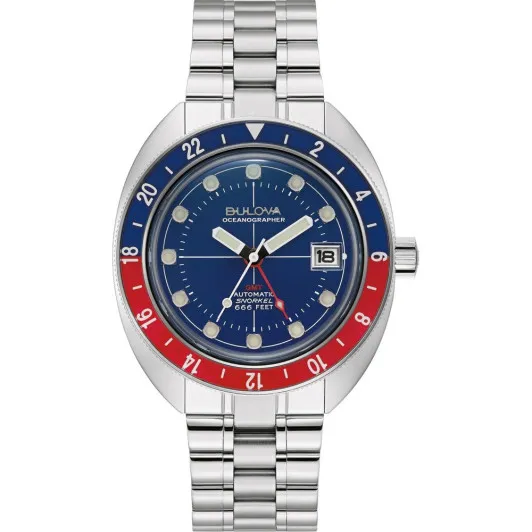
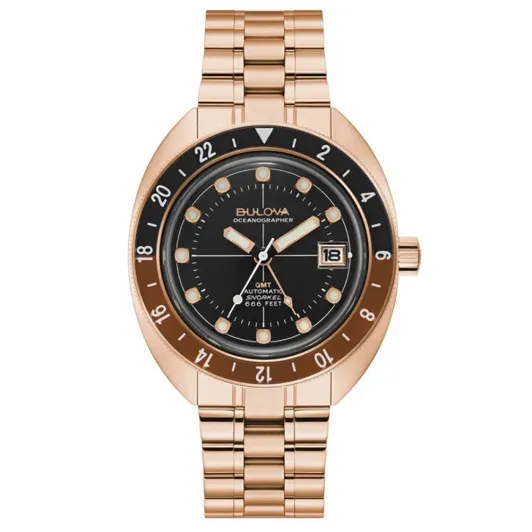
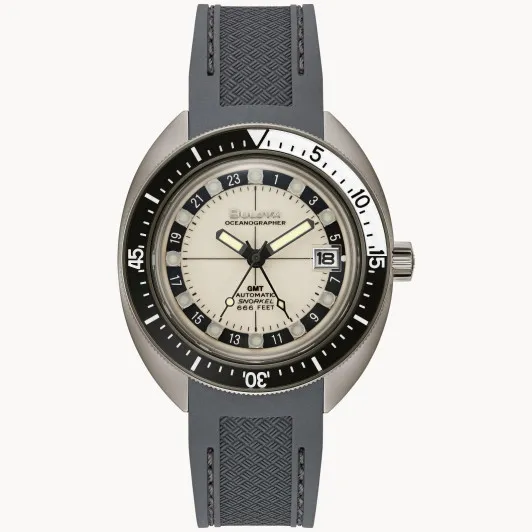
The Bulova Oceanographer is a dive-inspired line from Bulova, the New York-founded American watchmaker established in 1875 and long recognised for its precision quartz and proprietary high-frequency movements. The Oceanographer name traces back to one of Bulova's most iconic 1960s sport watches — a bold, rotating-bezel diver that helped define the American take on tool-watch design — and the contemporary reissues carry that heritage into modern production.
A revival rooted in the original 666 Feet diver
The original Oceanographer, introduced in 1969, was rated to 666 feet (approximately 200 metres) and featured a distinctive cushion-influenced case with an integrated rotating bezel. The current Bulova Oceanographer line draws directly on those design cues: the pronounced case architecture, the unidirectional elapsed-time bezel, and the bold dial layouts are all deliberate callbacks to the vintage reference. For buyers interested in watch history, this is one of the more faithful American dive-watch revivals available at its price point — not a loosely themed homage, but a design that references specific original details.
Choosing a Bulova Oceanographer
Because the selection is focused — a small number of references rather than a sprawling line — the main decisions come down to dial colour, bracelet or strap configuration, and finishing. Dive watches at this tier are typically built around stainless steel cases with screw-down or reinforced crowns and mineral or sapphire crystals; check the individual reference for crystal type if scratch resistance is a priority. Water resistance on purpose-built dive watches of this style is generally rated to at least 100 metres, with many references reaching 200 metres — sufficient for recreational scuba, not just splash protection. The Oceanographer sits in the mid-to-upper range of Bulova's wider catalogue, priced from around USD 1,350 to approximately USD 1,600, which places it among Bulova's more considered, heritage-led references rather than its everyday quartz pieces. For context on where this sits within the broader Bulova offer, the Bulova Precisionist line uses a proprietary high-frequency quartz movement (262 kHz versus the standard 32 kHz) for sweep-second accuracy, while the Bulova Marine Star covers the brand's broader sport and water-resistant range.
Who the Oceanographer suits
These are men's watches designed for wearers who want a sport-capable piece with genuine design provenance rather than a generic diver silhouette. The case proportions lean towards the substantial — consistent with the 1960s original — so they suit medium-to-large wrists well. As a daily-wear option, the rotating bezel and water resistance make the Oceanographer practical as well as historically grounded; as a collector's piece, the direct lineage to a named vintage reference gives it a narrative that generic sport watches lack. If you are weighing options across the wider watches category or want to compare other heritage-led designer watches, browsing by movement type and case size is the most efficient way to narrow down.
Is the Bulova Oceanographer a reissue of a vintage watch?
Yes. The Oceanographer name and core design language originate with a 1969 Bulova dive watch rated to 666 feet. The current production models are contemporary reinterpretations of that reference, updated in materials and movement but faithful to the original case shape and bezel format — not a purely new design that borrows only the name.